

The New Angel
Walter Benjamin #4: Agesilaus Santander
During his exile on the Spanish isle of Ibiza, Walter Benjamin composed an angelological meditation. Benjamin’s biographer Howard Eiland calls this essay “highly esoteric” and “one of the most peculiar he ever wrote.” Benjamin’s other biographer Gershom Scholem called it a “thoroughly hermetic text.”
This essay’s title, “Agesilaus Santander”, makes little sense at first glance (or on subsequent glances for that matter).
Agesilaus, as in the ancient king of classical Sparta?
Santander, like the port city on Spain’s Cantabrian coast?
For such questions Benjamin refuses to drop suggestive hints.1
Walter Benjamin wrote “Agesilaus Santander” as a gift for Anna Maria Blaupot ten Cate. The occasion was they met on the island of Ibiza in 1933; she was an artist; she was Dutch; she was a painter; and, according to a letter Benjamin wrote to Gershom Scholem, she represented the “female counterpart” to Paul Klee’s lithograph “Angelus Novus.”
Here’s the 1930 self-portrait of this essay’s target audience (Benjamin called her by the nickname “Toet”), a painting which now sits in the Museum Boijmans Van Beuningen in Rotterdam:

Captivated by her beautiful soul, Benjamin wrote her some theology for her birthday:
At every moment, God creates a whole host of new angels, whose only task before they return to the void is to appear before His throne for a moment and sing his praises.
The essay’s most vivid touchpoint is the image of God constantly producing new slews of angels whose final purpose is to worship the Holy One then disintegrate. Benjamin sources this idea to the Kaballah, leading us to locate its possible origins in Tractate Chagigah of the Babylonian Talmud:
Each and every day, ministering angels are created from the River Dinur, and they recite song to God and then immediately cease to exist, as it is stated: “They are new every morning; great is Your faithfulness” (Lamentations 3:23), indicating that new angels praise God each morning.2
—Chagigah 14a, Koren-Steinsaltz translation.
The midrash supports this ontology with a verse from Lamentations. The verse immediately preceding that one (quoted in Jewish daily prayers) adds context:
The kindness of the LORD has not ended,
His mercies are not spent.They are renewed every morning—
Ample is Your grace!—Lamentations 3:22-23, JPS translation3
Benjamin’s twist on this teaching is: what would happen if a person perverts the divine order of things by preventing one of these angels from reaching paradise? Having an unfulfilled purpose, the angel would be unable to return to the great emptiness. “I only fear that I had kept him excessively long from his hymn,” Benjamin writes of the Klee angel who had been his constant companion from apartment to apartment for the past decade (minus a brief period during which he entrusted the print to Scholem).
At this point in the essay it’s clear Benjamin’s not speaking of the Dutch woman as an angel, but of his “Angelus Novus,” the 1920 drawing by Paul Klee which became Benjamin’s prized possession when he bought it Munich in 1921 for a thousand Deutschmarks.
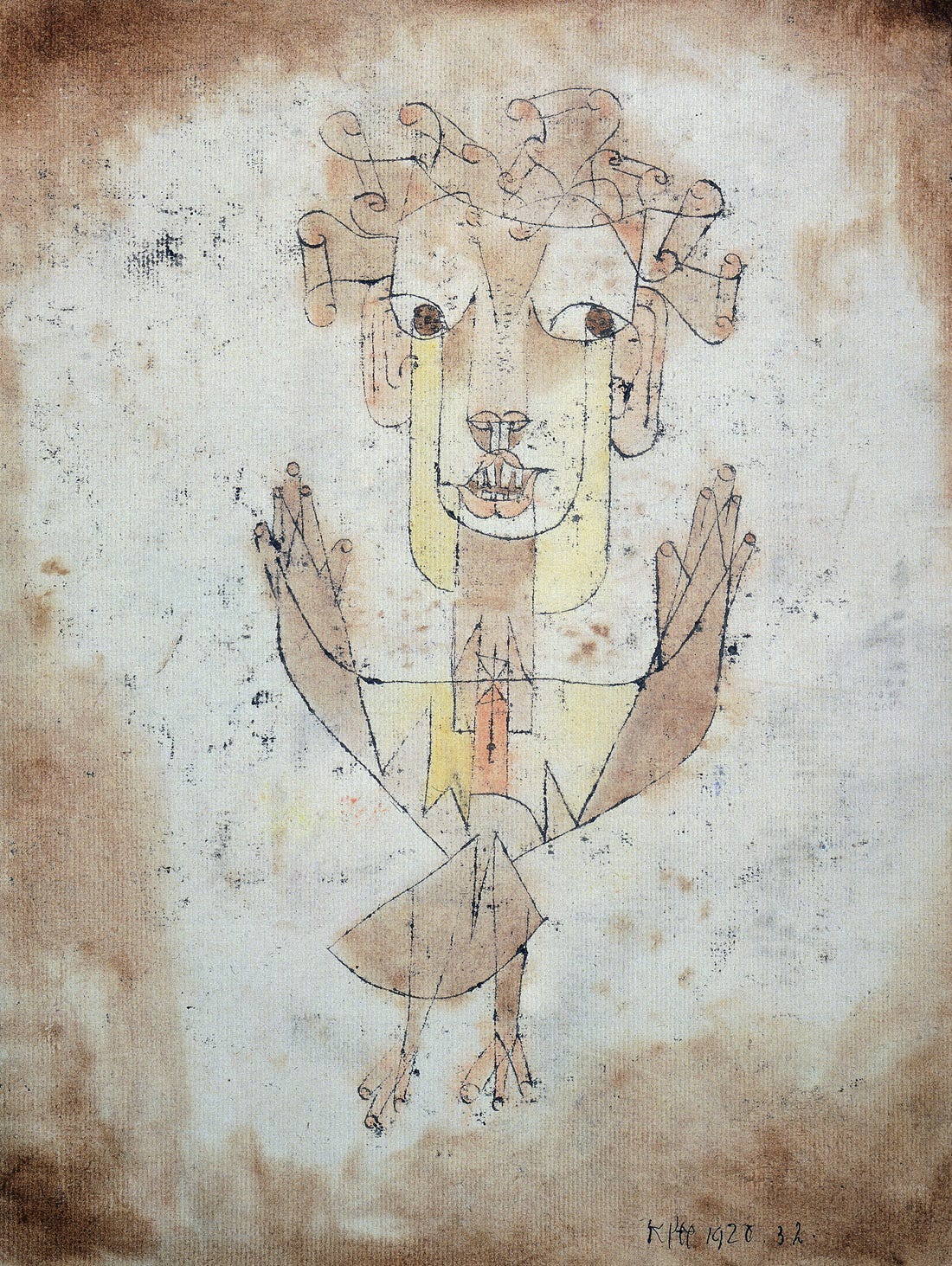
“In his conversations as well as in his writings, he frequently had occasion to speak of the picture,” Scholem commented about Benjamin’s obsession with this image. Benjamin’s most notable statement on this print was in the final essay of his life “On the Concept of History” (sometimes translated “Theses on the Philosophy of History”), wherein Benjamin devotes a famous paragraph to interpreting his favorite work of art.
There is a picture by Klee called Angelus Novus. It shows an angel who seems about to move away from something he stares at. His eyes are wide, his mouth is open, his wings are spread. This is how the angel of history must look. His face is turned toward the past. Where a chain of events appears before us, he sees one single catastrophe, which keeps piling wreckage upon wreckage and hurls it at his feet. The angel would like to stay, awaken the dead, and make whole what has been smashed. But a storm is blowing from Paradise and has got caught in his wings; it is so strong that the angel can no longer close them. This storm drives him irresistibly into the future, to which his back is turned, while the pile of debris before him grows toward the sky. What we call progress is this storm.4
The marxist literary critic Frederic Jameson snarks that this image bears “very little in common with Benjamin’s description of it.” Jameson draws a clear parallel between the piece of Midrashic trivia contained in the earlier essay “Agesilaus Santander” and the critical reading of this same image in Benjamin’s later essay “On the Concept of History” when he observed how Klee’s angel “comes from a family of ephemeral angels, those created to praise the moment—the Now, the Jetztzeit—and then at once to vanish along with it. Is it that, surveying the immense garbage dump of history, today’s mountains of non-biodegradable plastic, this particular angel finds itself incapable of singing the praises of a present to which it has been assigned and, mute, is therefore unable to vanish?”5
Gershom Scholem, who analyzed Benjamin’s “Agesilaus Santander” essay in an essay of his own6, suggests one resolution to this hypothetical scenario (where an angel is forced to delay his return to nothingness) in the Genesis narrative. An angel of this same genus, that of the self-destructing singers who get “renewed every morning,” wrestled with the patriarch Jacob.7 To concede his altercation with Jacob, the angelic fighter announced:
“Let me go for the dawn is coming… I am an angel and since I have been created the time has until now not come for me to say my hymn [before God], but just now the hour for the singing has come”.
The action of dislocating Jacob’s hip is this angel’s retribution to Jacob for causing him to delay his swan-song before the Almighty.8
This Angel of History is one who fails to accomplish his purpose— in part he can blame his failure on the impossibility of his task (“to stay, awaken the dead, and make whole what has been smashed”). Such tikkun can only be accomplished, as Scholem points out, by the messiah.
Scholem has argued the title is an anagram for “Der Angelus Satanas;” I find his explanation unconvincing insofar as it fails to explain the presence of an extra unused letter.
And in case we want to know what’s the River Dinur, another legend states that the creatures who carry on their shoulders the isle of paradise and the throne of God sweat profusely from bearing their heavy burden. Their perspiration drops off their bodies like fire and converges into the river of fire known as the river Dinur.
So these angels, whose sole task is to sing praises before the throne of paradise and finally to dissipate forever, act as God’s agents for administering His kindness and His mercy.
Benjamin, Walter. “On the Concept of History” in Selected Writings, Volume 4: 1938–1940, ed. Howard Eiland and Michael W. Jennings, trans. Harry Zohn. Belknap Press of Harvard University Press, 2006, page 392.
Jameson, Frederic. The Benjamin Files, Verso Books, 2022, p. 219.
Scholem, Gershom. “Walter Benjamin and His Angel.” On Jews and Judaism in Crisis, Schocken, 1976, pp. 198–236.
Genesis Rabba 78, §1.
Scholem clarifies at this point that while Benjamin’s focus in this essay is this species of angel of this singing-and-vanishing variety, there are others who persist for very long stretches time, for example the archangels.